
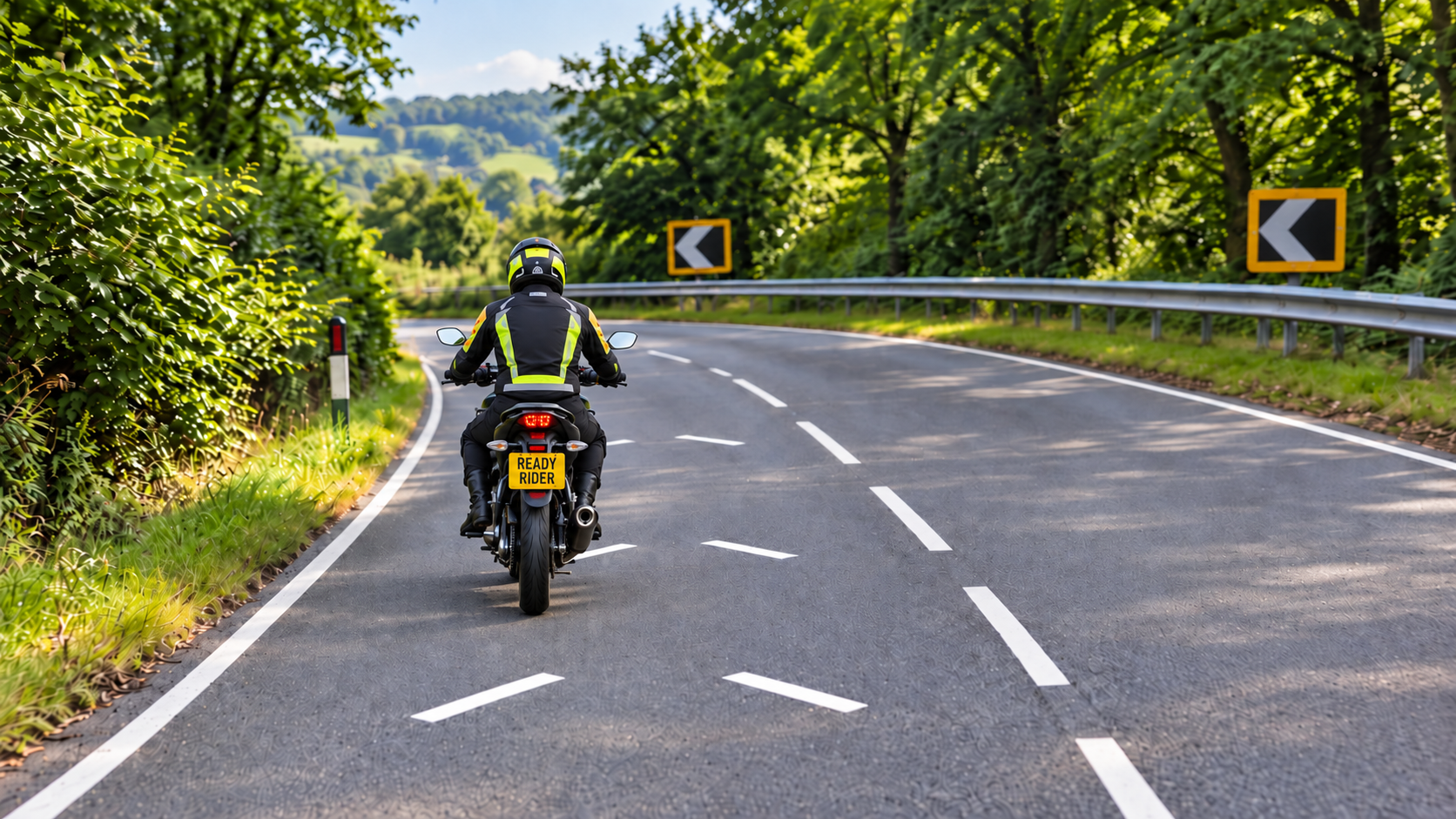
We all know that feeling when a bend tightens a little more than expected. Get our speed or position wrong on the way in and suddenly we’re using far more road than we intended.
And that matters. Cornering, particularly on sharper left-hand bends, remains one of the manoeuvres where riders can get themselves into serious trouble.
Quite often it starts with the position we take on the approach. Add a little too much speed and, as the bend develops, we can find ourselves drifting towards the centre of the road – exactly where we don’t want to be if something is coming the other way.
That’s where PRIME markings come in.
We’ve talked about them before, but they’re well worth another look. PRIME stands for Perceptual Rider Information for Maximisation of Enjoyment and Expertise and was originally trialled in Scotland specifically with motorcyclists in mind.
The idea is beautifully simple. Three pairs of truncated chevrons are painted on the road, creating a visual ‘gate’ for us to ride through as we approach the bend.
Rather than telling us what to do with another sign, the markings gently guide us towards a better position on the road – helping improve our view through the bend, our control of the bike and our awareness of what might be coming next.
They also appear to encourage us to knock a little speed off on the approach.
So, do they actually work?
The evidence so far looks really encouraging.
Researchers looking at 47,770 motorcycle movements across 23 sites found significant improvements in rider positioning and reductions in speed. Harsh braking also reduced at 18 of the sites studied.
National Highways has been looking at a trial in England too, while several Scottish local authorities have considered introducing PRIME markings more widely.
For something as simple as a few carefully positioned road markings, that could make a very worthwhile difference.
But markings or no markings, good cornering still comes back to what we do as riders.
A useful way of remembering it is the three Ps: Preparation, Path and Posture.
Preparation
Before we reach the bend, we want to know as much as possible about what’s waiting for us.
Look well ahead and pick up the clues. Can we see the exit? Does the bend tighten? Are there junctions, hedges, gravel, standing water or anything else that could catch us out?
Where possible, try to be looking several seconds ahead rather than simply at the piece of tarmac immediately in front of the wheel.
Road signs and markings help too. Advisory speed signs, chevrons and double white lines are all telling us something about what lies ahead.
And don’t forget the road surface itself. Camber can help us through a bend, but an adverse or changing camber can make the bike feel very different indeed.
Then there’s speed.
Most of us would rather enter a bend thinking, I could have taken that slightly quicker, than get halfway round thinking, I really wish I’d slowed down more.
Get our speed right before the corner. That gives us time, space and options – and lets us build the throttle smoothly as the road opens up again.
Path
Our road position should always be about getting the best possible view without putting ourselves at risk.
Where it’s safe, choose a position that lets us see as far through the bend as possible while maintaining a good safety margin from oncoming traffic, road edges and other hazards.
And remember: the best position can change as the bend develops.
We should always be asking ourselves: If something appeared around that corner right now, have I left myself somewhere to go?
That question is especially important on left-hand bends. Running too close to the centre line can put us dangerously near an oncoming vehicle – particularly one whose driver decides to straighten the bend.
There’s no prize for clipping an imaginary apex perfectly. We’re riding on a public road, not a racetrack.
The safest line is the one that gives us the best combination of vision, space and control.
Posture
Then there’s what we’re doing on the bike.
A useful old riding phrase is: firm below the hips, relaxed above.
Use our legs and knees to give ourselves a stable base, but keep the shoulders, arms and hands relaxed. A death grip on the bars rarely makes anything better.
Keep the head up and look where we want the bike to go. Our eyes are hugely important when cornering – stare at the hedge, kerb or centre line and that’s exactly where we’re likely to head.
Instead, turn the head and look through the bend towards the road opening up ahead.
At very low speeds the technique changes slightly and we may counterbalance the bike, but at normal road speeds we want our movements to be smooth, controlled and unhurried.
The same goes for braking and acceleration.
Smooth inputs help keep the bike settled. Sudden braking, steering or throttle changes when we’re already committed to a bend can quickly use up the grip we were relying on.
The aim isn’t to attack every corner.
It’s to arrive, read it, position ourselves properly, carry the right speed and ride through with enough in reserve to deal with whatever might be waiting around the bend.
And when we get all of that right?
That lovely, flowing feeling when rider, bike and road all seem to work together is hard to beat.
Prepare well. Choose a safe path. Stay relaxed on the bike. And if you spot PRIME markings on the road, use them – they’re there to help us come out of the bend smiling.